

What is the SE ZERT Program?
The SE ZERT® program is a part time professional training program leading to the Certified Systems Engineer (GfSE)® qualification. It provides participants with the opportunity to develop both process related and technical competencies in the field of Systems Engineering.
The program was developed by GfSE e.V. in cooperation with TÜV Rheinland as a personnel certification scheme. It is based on the requirements of EN ISO/IEC 17024 for the certification of persons. Accredited training providers prepare participants independently and thoroughly for certification. The examination is conducted by the SE ZERT® Assessor Group examination committee of GfSE e.V., which evaluates candidates on their Systems Engineering knowledge. This approach ensures a consistently high standard of professional education. Holders of an SE ZERT® certificate are qualified to work as Systems Engineers across a wide range of industries. The program is offered worldwide in both German and English.
SE ZERT® is intended for individuals with technical qualifications ranging from master craftsperson and technician certifications to bachelor's degrees, master's degrees, and equivalent legacy university degrees. It also enables companies to qualify their employees through in house training programs or participation in public courses.
In accordance with the statutes of GfSE e.V., the objective is to establish a common Systems Engineering standard, a shared professional language, and a consistent professional profile for Systems Engineers.

Qualification Levels
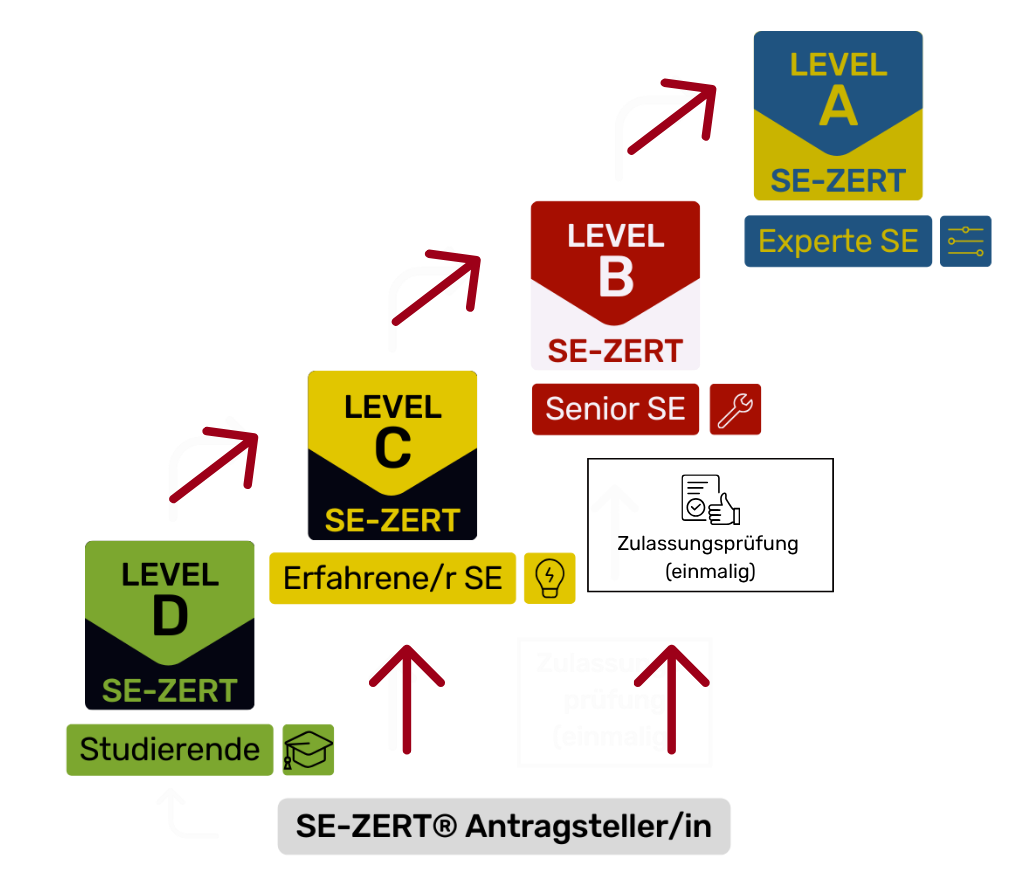
SE-ZERT® Level A provides comprehensive systems engineering skills at the highest level. Participants learn to lead complex projects and multidisciplinary teams with professional and technical responsibility.
Prerequisites include a Level B certificate and an independently prepared term paper that includes self-reflection. The examination consists of an evaluation of this term paper and a 60-minute technical interview.
The certificate is valid for 3 years and can be renewed through recertification.
SE-ZERT® Level B teaches the confident application of systems engineering methods in moderately complex projects. Participants learn to lead subprojects or projects of limited complexity, as well as small multidisciplinary teams.
Prerequisites include a Level C certificate, an approved training course, and at least 80% attendance. The exam consists of 50 questions to be completed in 120 minutes; a score of 67% or higher is required to pass.
The certificate is valid for 3 years and can be recertified.
SE-ZERT® Level C provides in-depth knowledge of systems engineering and its methods. The goal is to enable qualified participation in projects and multidisciplinary teams, as well as to assume technical responsibility.
Prerequisites include completing an approved training course and achieving at least 80% attendance. The exam consists of 50 questions to be completed in 120 minutes, and a score of 67% or higher is required to pass.
The certificate is valid for 5 years and can be renewed through recertification.
SE-ZERT® Level D is intended for graduates of accredited master’s degree programs. The program provides an in-depth understanding of the fundamentals of systems engineering as well as the ability to contribute to projects and multidisciplinary teams.
Proof of enrollment from the university is required. The exam consists of 50 questions to be completed in 120 minutes, and a score of 67% or higher is required to pass.
The certificate is valid for 5 years and can be upgraded to Level C upon demonstration of relevant professional experience.
Program Structure
The Certified Systems Engineer (GfSE)® training program is divided into nine modules.
The SE ZERT® module content is identical across all certification levels. However, the competency requirements differ depending on the selected certification level, whether A, B, C, or D.
Training courses with final examinations are available for Levels B and C. Level A requires the preparation of a written thesis followed by an oral examination to demonstrate competency. Supporting documentation is available for download for each certification level.
| Moduls |
1 | Fundamentals of Systems Engineering including an introduction |
2 | Cross project interfaces |
3 | Interfaces between Systems Engineering and Project Management |
4 | Systems Engineering Management |
5 | Requirements Management, Validation, and Verification |
6 | Realization processes |
7 | Cross functional activities within development projects |
8 | Consideration of operational aspects and decommissioning during system design |
9 | Conflict management and interpersonal skills |
The competency areas required for certification are based on the technical competencies that should be applied in every project, with the exception of a general introductory area covering Systems Engineering in context.
Additional competency areas include Project Management, cross functional topics, and soft skills.
Training in the technical competencies is primarily based on the relevant sections of ISO IEC IEEE 15288, the interpretation provided by ISO IEC 19760, the terminology defined in ISO IEC IEEE 24765:2010, and the INCOSE Systems Engineering Handbook.
ISO IEC IEEE 15288 is an internationally recognized process based standard that forms the foundation of Systems Engineering activities. Developing process related competencies is therefore a key objective of the training program.
These competencies include the methods, knowledge, skills, and practical abilities that participants are expected to understand and apply by the end of the course. This enables participants to transfer their knowledge directly into their daily professional work.
Since Systems Engineers typically work in interdisciplinary project teams, the development of interpersonal and social competencies is equally important. The program therefore also draws upon Project Management standards and established literature from facilitator training.
Further information

Would you like to become a certified systems engineer? Find out what qualification levels are available and how you can take the next step in your career.

The GfSE assessors are experienced systems engineers from industry and academia. They are responsible for the curriculum and exams, as well as for the accreditation of training providers.

Play an active role in shaping the future of systems engineering. As an accredited training provider, you’ll support professionals on their path to becoming Certified Systems Engineers® and benefit from an established, cross-industry certification standard. Learn more about the requirements, benefits, and the process for becoming an accredited training partner.
SE ZERT® Compared with INCOSE SEP
The SE ZERT® program fills an important gap in the certification market by providing a unified Systems Engineering perspective. INCOSE represents the world's largest international Systems Engineering network. Its Systems Engineering Professional certification follows a certification philosophy that is primarily aligned with practices in the United States, similar to the Project Management Institute in the field of Project Management. The European perspective is traditionally represented by GPM and IPMA. In Systems Engineering, both certification approaches originate from the same global professional community. SE ZERT® represents the European approach while remaining closely connected to the international Systems Engineering network.
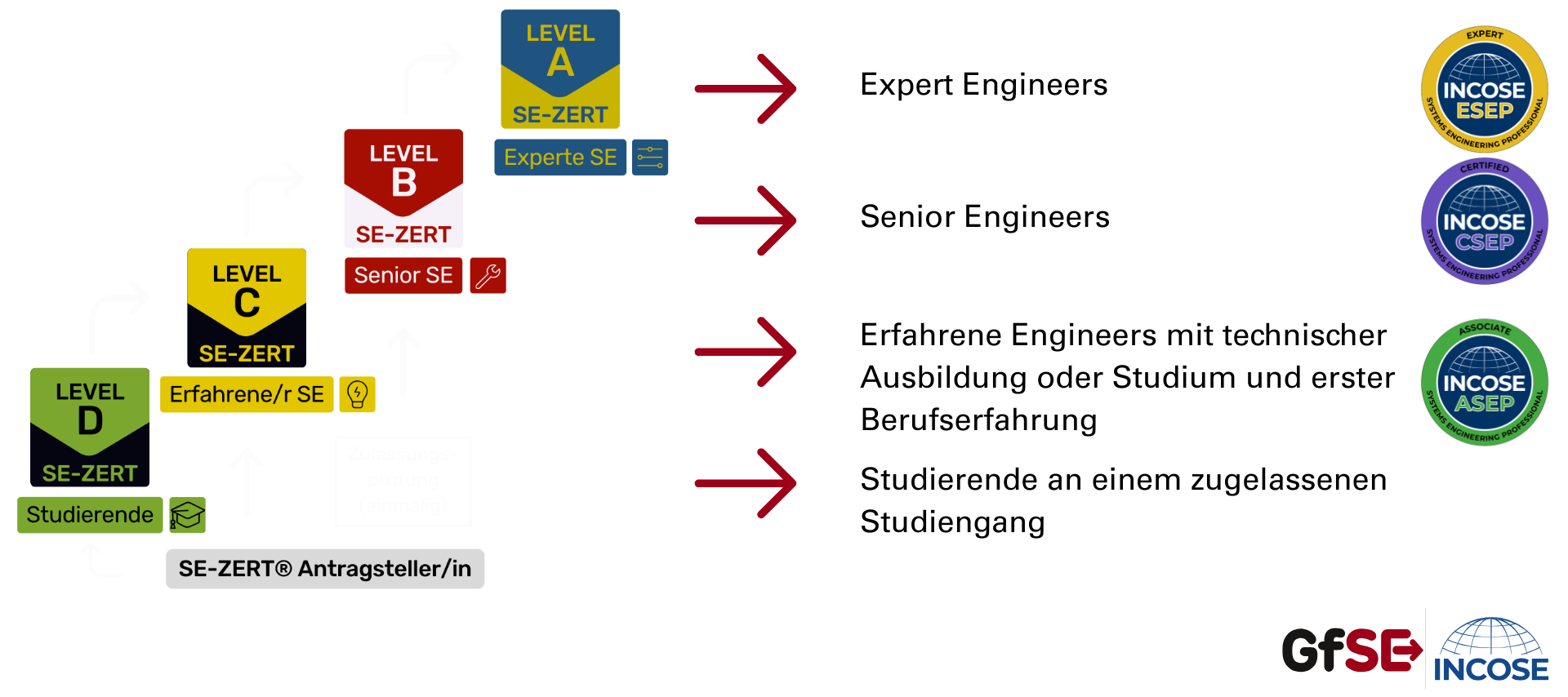
The SE ZERT® program covers a broader range of topics than the INCOSE Systems Engineering Professional certification. The audited training program places particular emphasis on cross functional topics and includes dedicated instruction in soft skills. Participation in a licensed training course is mandatory and combines theoretical instruction with practical exercises. This creates a high standard of professional education that is verified through examinations consisting of both multiple choice and open response questions. The INCOSE certification examination, by comparison, consists exclusively of multiple choice questions.
Even non-members of the GfSE can convert their SE-ZERT into an international certificate.
Prices for converting an SE-ZERT certificate into a INCOSE-SEP:
|
|
Members |
|
New Application |
Netto: 200,00 € Brutto (incl. 7 % MWSt): 214,00 € |
|
Extension |
Netto: 105,00 € Brutto (incl. 7 % MWSt): 112,35 € |
|
Non-Members |
|
|
ASEP (New Application or Extension) |
Netto: 860,00 € Brutto (incl. 7 % MWSt): 920,20 € |
|
CSEP (New Application or Extension) |
Netto: 992,00 € Brutto (incl. 7 % MWSt): 1.064,44 € |