

The Qualification Levels
The “Certified Systems Engineers (GfSE)®” training program is divided into 9 modules. The module content for SE-ZERT® is the same for all levels of SE-ZERT®. However, the competency requirements vary depending on the selected level (A, B, C, or D). Training courses with final exams are offered for Levels B and C. For Level A, a written paper must be submitted, and competency is assessed through a final oral exam. Corresponding documents are available for download for each level.
The SE-ZERT® program enables anyone who has completed technical training to obtain the certificate. SE-TREC GmbH grants admission to the exam after reviewing the submitted documents. Training providers are available to assist with preparing the documents and answering questions, and will consult with SE-TREC GmbH as needed. There is no requirement for personal membership in the GfSE. Members receive a discount.
SE-ZERT® Level A provides comprehensive systems engineering skills at the highest level. Participants learn to lead complex projects and multidisciplinary teams with professional and technical responsibility. Prerequisites include a Level B certificate and an independently prepared term paper that includes self-reflection. The examination consists of an evaluation of this term paper and a 60-minute technical interview. The certificate is valid for 3 years and can be renewed through recertification.
SE-ZERT® Level B teaches the confident application of systems engineering methods in moderately complex projects. Participants learn to lead subprojects or projects of limited complexity, as well as small multidisciplinary teams. Prerequisites include a Level C certificate, completion of an approved training course, and at least 80% attendance. The exam consists of 50 questions to be completed in 120 minutes; a score of 67% or higher is required to pass. The certificate is valid for 3 years and can be recertified.
SE-ZERT® Level C provides in-depth knowledge of systems engineering and its methods. The goal is to enable qualified participation in projects and multidisciplinary teams, as well as to assume technical responsibility. Prerequisites include completing an approved training course and achieving at least 80% attendance. The exam consists of 50 questions to be completed in 120 minutes, and a score of 67% or higher is required to pass. The certificate is valid for 5 years and can be renewed through recertification.
SE-ZERT® Level D is intended for graduates of accredited master’s degree programs. The program provides an in-depth understanding of the fundamentals of systems engineering as well as the ability to contribute to projects and multidisciplinary teams. Proof of enrollment from the university is required. The exam consists of 50 questions to be completed in 120 minutes; a score of 67% or higher is required to pass. The certificate is valid for 5 years and can be upgraded to Level C upon demonstration of relevant professional experience.
Professional Experience
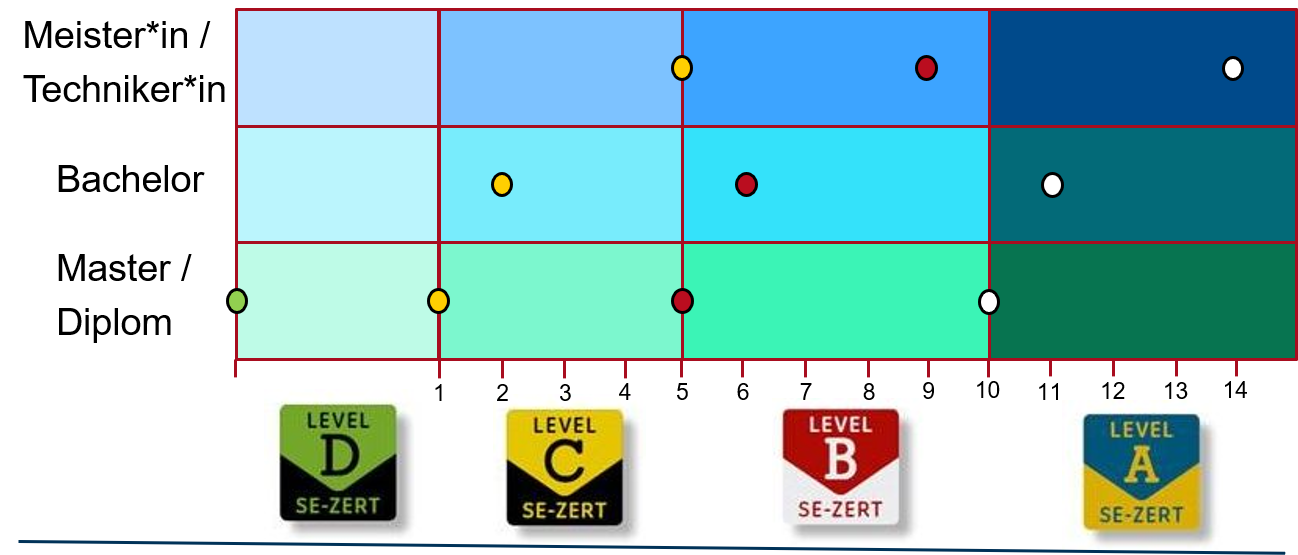
Depending on prior knowledge and professional experience, the various levels of the certification can be attained. To be eligible to take the exam for Levels C through A, candidates must have completed technical training as a master craftsman or master craftswoman, a technician, or hold a technical degree—such as a Bachelor’s, Master’s, Dipl. Ing. FH, or Dipl. Ing.—along with a minimum amount of professional experience. Level D is exclusively for graduates of an accredited master’s degree program.
In addition, the certification body may make case-by-case decisions in which specific professional backgrounds are reviewed for comparability with the stated admission requirements. The following chart provides a concise overview.
Professional experience must be documented in the application and confirmed by the employer. Self-employed individuals must provide references demonstrating practical experience in the field of systems engineering. Work as a student employee is part of an educational program and therefore cannot be counted toward the requirement.
Levels B, C, and D differ in the exam based on the number of questions and the level of difficulty. The exam lasts 120 minutes and includes both multiple-choice and open-ended questions. A score of 67% of the total possible points is required to pass the exams. For Level A, a term paper with an assessment is required.
To be eligible, applicants must demonstrate experience in at least 3 areas of competence. The number of months required varies depending on the qualification level. These competency areas from professional practice are as follows:
- Requirements Management
- Risk and Opportunity Management
- Configuration Management
- Technical Planning
- Estimation of Technical Effort
- Architecture Design/Development
- Qualification, Verification, Validation
- Process Definition
- Tool Support
- Systems Engineering Continuing Education
- System Integration
- Quality Assurance
- Specialized Engineering Activities according to the INCOSE Handbook (e.g., logistics, maintenance, reliability, servicing, compatibility, environment, safety, etc.)
The three core curricula for the SE-ZERT®, Levels C/D, B, and A, share a common basic structure: They specify content-related and process-related competency requirements that must be linked together. The SE-ZERT® core curricula adopt this basic structure from subject-specific perspectives. The intended pedagogical approach of each module (1–9) becomes clear through the selection and combination of competency levels.
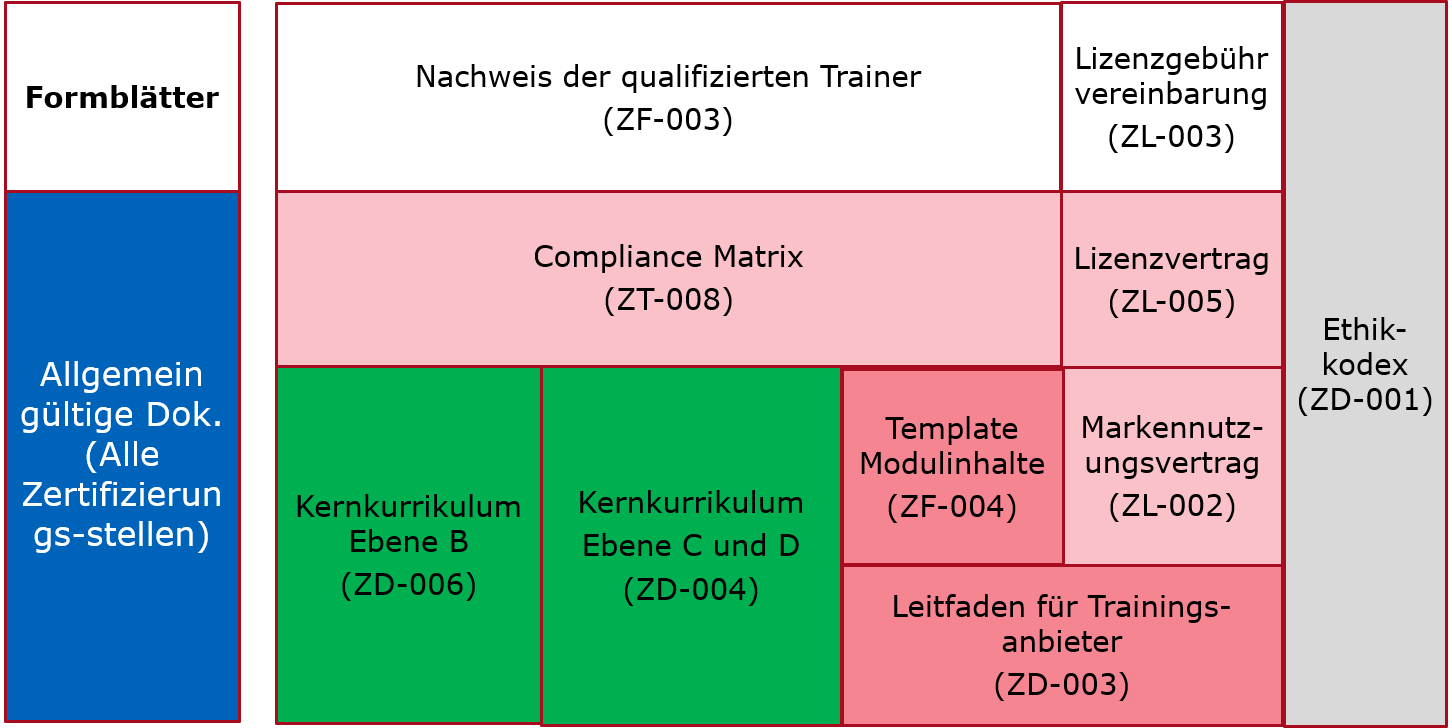
Overview of Valid Documents
Competency Levels
For each module element, a competency level (understand, apply, master) is defined as the guiding principle, which determines the level of knowledge participants are expected to have in the respective module upon completion of the training.
|
Competency Levels |
Interpretation |
|
Mastery |
Can independently apply, delegate, manage, evaluate, and teach the procedure |
|
Application |
Can understand the procedure and apply it in its entirety |
|
Understanding |
Is familiar with the concept and can classify it within the relevant SE area |
|
N/A |
Not applicable |
For each level, there are examination regulations that provide further details on the process and are available for download